

Articles on San Juan de Limay from the recent past
Voice in the Wilderness – 1985
Violence in the North – 1993
Nicaragua’s Suffering Continues – 1997
The Hardships of Life in Limay – 1997
Re-establishing Old Ways – 1998
Hurricaine Mitch – 1998
The Flight to Other Places- 1999
The Roads – 2000
Drought – 2002
Voices in the Wilderness by Kathy Kelly – reprinted from antiwar.com
For my part, it was important to recall experiences tracing back to 1985, when I traveled to San Juan de Limay, in the north of Nicaragua. Children there were radiant and friendly, many of them too young to understand that during the previous week, U.S.-funded Contras had kidnapped and murdered 25 people in their village. Later that summer, I fasted with Nicaragua’s Foreign Minister, Rev. Miguel D’Escoto, himself a Maryknoll priest, and listened to stories pour forth as many hundreds of Nicaraguan peasant pilgrims vigiled and fasted in the Monsenor Lezcano church to show solidarity with the priest-minister’s desire to nonviolently resist Contra terrorism. Rev. Miguel D’Escoto urged those of us from the U.S. to return to our homes and there develop nonviolent actions commensurate to the crimes being committed. This experience gave me reason to believe that the U.S. could have used negotiation and diplomacy to resolve disputes with Nicaragua.
Violence in the North of Nicaragua, 1993 – From the Inter-American Commission on Human Rights
One of the most serious problems facing the Nicaraguan Government since April 1990, has been the demobilization of former members of the Nicaraguan Resistance Movement. To this end, the Government made a number of commitments aimed at reabsorbing these men back into civil society including grants of land and other resources to enable them to engage in productive work. For their part, both the former Resistance members and the former members of the Sandinista People’s Army (EPS) made an undertaking to turn in their arms, however, since July 1991, and despite the fact that the disarmament process has been completed, groups of former Resistance fighters are still operating in the north of the country, claiming among other things, a climate of insecurity brought about by the arbitrary nature of Army and Police actions, together with failure on the part of the Government to meet its undertakings to provide land and bank credit. Moreover, former members of the EPS have taken up arms again on the grounds that they feel threatened by the actions of the other groups. Quite clearly–on the basis of the information provided–civil society is unprotected against the violence and criminal acts perpetrated by both groups coupled with the disproportionate response of the Army and Police in seeking to put down rebel actions in both the rural and the urban areas.
According to information furnished to the IACHR, there are apparently some 1,200 armed men operating in the north of the country who, in the first six months of the year, have been the cause of 62 deaths, 44 abductions and more than 120 attacks on civil vehicles. Because of this violence, on May 18, 1993, the President of Nicaragua, Violeta Barrios de Chamorro, suspended certain constitutional guarantees for a 30-day period. The guarantees suspended the inviolability of the home, the requirement of a court order to detain a person and the requirement that an individual not be held for longer than 72 hours during a police investigation. The municipalities and provinces covered by these measures were: QuilalÃ, JÃcaro and Murra in Nueva Segovia; San Juan de RÃo Coco in MadrÃz; and San Juan de Limay, Pueblo Nuevo and Condega in EstelÃ.
Nicaragua’s Suffering Continues by Gretchen Kaufman reprinted with permission from The Baltimore Journal , June 1997
Living is not so different in our distant sister city, Limay, Nicaragua. It may have a different culture, different expectations, a different meaning of the word “poverty,†but there are families and friends and neighborhoods known by heart. Sara “Sally†Matlin-or “Sarita†to her Nicaraguan friends-has spent the last three months in Limay working with Casa Baltimore/Limay (CB/L), an organization that connects our community with one that needs our help.
Ms. Matlin came back to the U.S. from May 24 to June 5 to educate Baltimoreans on the problems faced in Limay and the part our own government plays in the plight of the Nicaraguan people.
The current president of Nicaragua, Arnoldo Alemán, rose to power in 1996 by sabotaging the elections, leaving competitos’ ballots uncounted in warehouses and open fields. According o Ms. Martlin, Alemán, a right wing extremist and friend of U.S. Senator Jesse Helms, wants to put an end to college scholarships and has already rendered it impossible for people who don’t already have revenue to get a loan. In Nicaragua, few can rise frompoverty, reports Ms. Matlin, who says Alemán is using policy to draw a dividing line between those in power and those in the communities.
“He promised to create jobs but the promise was empty,†she said. “As soon as he stepped into office he executed many politically motivated firings, leaving seventy percent of the population jobless.â€
Those loyal to the Somoza dictatorship fled to America when the Sandinistas came to power and appropriated their land. This land was split up among the farmers who had lived and worked on that land all their lives. This change in ownership, however, was never made legal by contract or title deed. Now Alemán is evicting farmers and their families from this land.
Ms. Matlin’s summary of the situation in Nicaragua today: there is homelessness, there is poverty, there is alcoholism, and there is rampant misuse of power by the national government. Sally Matlin is working to combat Nicaragua’s deadly poverty at the grassroots level. One resource available is the Philip Mitchell Revolving Loan Fund, set up to provide loans to people who cannot get them any other way. Loans of around $200 are being given to workers who need tools, to women who need help with small businesses, and, most recently, to small farmers who need capital to hold on to their crops until they can get market value for them.
UNAG, the Nicaraguan Union of Small Farmers and Ranchers, has begun implementing a new sustainable agriculture project in communities, promoting a self-sufficient, nondestructive way of farming.
Limay is essentially desert now, due to deforestation. To save the land, the UNAG will use such methods as reforestation, organic farming and composting, soil and water conservation and crops that will rejuvenate the soil instead of stripping it. Sally Matlin hopes CB/L will accept the project and allow UNAG to go to work in Limay. CB/L also began a child care center in Limay that has evolved into a nutrition center for undernourished children. Unfortunately, Casa Baltimore did not have the money to continue supporting the venture, so L’esquirol, an organization based in Cataluna, Spain, is now the primary supporter. Current funding is sufficient to keep the doors open, but is not enough to do everything that needs to be done.
“I know in Limay there isn’t enough and there should be more; and I know in America there is too much and there should be less. But where is the ideal?â€Sally Matlin asks.
The 25-year-old anthropology graduate of Stanford University struggles to describe the two worlds she lives in, and the confusion inherent in going from a place where on any given day it is hard to find an egg to one where 20 different kinds of deodorant are displayed in supermarkets.
No one cares about deodorant when people are dying. “That’s one important difference,†says Sally Matlin. “People in Nicaragua can’t deny reality.â€
San Juan de Limay by Claudia von Vacano Oberlin College 1997
“San Juan de Limay,†the words themselves tell the story of this once stormy and now dormant town. During the revolution, suspicion hung heavy in the air. People never knew who to trust, who would take their children away to fight. Contras against Sandinistas, at times brothers spilling each other’s blood. The Sandinistas were supposed to end hunger. The Contras were going to reclaim the country and turn it into a democracy. Time has passed. Much has happened. But hunger remains in San Juan de Limay.
And yet there is a quiet poetry in this town. As you walk away from the heart of the town, the sky cracks open and unveils a majestic landscape. When families and friends come together, smiles reveal immeasurable beauty and hearts ring truth.
The small, dust-ridden town of San Juan de Limay is located on the outskirts of the city of EstelÃ. Bus transportation to and from Limay is available six times a day. But poor families can seldomly afford to travel to EstelÃ. And most people travel by foot or horseback within Limay. Geovanny Castellón speaks for many neighbors when he utters, “I feel trapped at times in this pueblucho (a dirty, old town.)â€
Running water can only found in the center of town, not in the outlying villages. Due to contamination, orders have been given to shut down these wells in Limay. “They tell us to close our wells, but they don’t provide us with electricity for running water,†complains Miriam Dávila. Many townspeople continue using these wells because electricity shortages cut off the water flow.
“Only rice and beans don’t fail us,â€declares Gioconda Pino, a campesina union leader.
Corn, beans, ayote, and coffee are staple foods grown in the area. Milk, cuajada (a cheese preserved by large quantities of salt and does not need refrigeration), eggs, and meat are luxury foods that are rarely eaten in Limay. This region is extremely arid and it is difficult to grow vegetables in this climate. Malnutrition is a serious problem in San Juan de Limay and poverty is the culprit. You can see children with aged faces, adolescents trapped in dwarfed bodies, and hair bleached because of an insufficient diet. Gastritis is common in Limay because hunger can cause neighbors to consume excessive amounts of coffee. Enrique Rosales explains, “I suffer from bad stomach aches, last summer it was so bad that I was hospitalized. My family gets angry with me because they say I don’t want to eat and get on my horse and go straight to the finca (farm) only having had my coffee. I feel guilty every time I eat.â€
Respiratory problems are another common health problem in San Juan de Limay. When Lester Rosales, a seven year-old boy, was asked how long he had his cough, he responded, “Always. I can’t remember when I didn’t have it.†The causes include: dirt roads that kick up dust and wood-burning stoves, which do not have chimneys to force smoke outside the homes. When asked about the quality of health care in town, a patient of Limay Clinic replied, “there are many doctors, but not enough medicine.â€
In respect to education, Limay is facing a crisis because of monthly tuition rates introduced by Nicaragua’s “autonomous†system. Under the Literacy Crusade, “autonomous†implied freedom from dictatorial oppression. Now, this word signifies the end of state-sponsored social welfare programs and economic dependency on the central government. “They say autonomous, but we know it is privatization,†stated several teachers in Limay.
Re-establishing Old Ways
An article in the 1998 Spring Bulletin of the Web publication Plenty, (www.plenty.org) tells more about the situation in Limay at that time.
This group of 30 women from San Juan de Limay, Esteli, Nicaragua is trying to rescue/reestablish home gardening practices their grandmothers employed, but that were for the most part lost during the past 25 years of war and social conflict within the country. After many years of deforestation under the government of Somoza, and the burning of forests during the conflicts in the 1980s, this area of Nicaragua became one of the driest and poorest regions in the country. People living in the village of San Juan de Limay are geographically isolated and have very limited means of earning money to pay for their basic life necessities, including food, medicine, clothing and schooling for their children. Sixty kilometers of rocky dirt roads separate San Juan de Limay from the nearest source of vegetables and fruit, in the city of Esteli. The high cost of traveling and purchasing this food in the market of Esteli make it impossible for most families in San Juan de Limay to access all of the food they need for their children.
Hurricaine Mitch
In October of 1998, Hurricaine Mitch devastated parts of Central America and this area of Nicaragua. The hurricaine left at least 9,000 , 2 million homeless and caused billions of dollars in damage throughout the region. Thousands of families in Nicaragua were forced to live in huts made of plastic and scrap wood erected immediately after the hurricane. San Juan de Limay was devastated by the catastrophe, having hundreds of homes destroyed and many lives lost. Many of their clean water wells were ruined, and 90% of the arable land was lost, having been buried under 3 to 6 feet of huge rocks and sand.
An article from the February 1999 edition of “Contigo†has this reflection by the Cuban doctors and nurses who came to aid the people of San Juan de Limay.
Limay after the devestation: By Orlando Oramas Leon
To reach San Juan de Limay, one has to climb a rocky mountain path made almost impassable by the rains accompanying Hurricane Mitch. The truck used to transport the medical brigade dispatched from Cuba got bogged down at one of its bends. In spite of their preparation, during the wait to be rescued the Cubans were unable to imagine how much desolation lay ahead of them. The Cuban brigade puts no limits on its humanitarian mission. Like others in the area, Lucia suffers from diseases brought about by poverty. Limay is encircled by mountains and various communities lived on its outskirts, along the banks of rivers that were formerly their source of life. The hurricane didn’t change the way of things, it worsened them. The flooding left hundreds of campesinos homeless, and I won’t say without a future because their future was uncertain before the hurricane struck. Much of the land will be useless for years. The last harvest was in full swing when it was lost and the rehabilitation of the land requires resources beyond the reach of people like Julia Morales Espinoza’s family, who have taken refuge in the Samuel Vindell school. None of them has shoes, although that’s not their principal concern.
“The river flooding took away our home, there in the barrio of Guadalupe. It was the only thing we had, as we had no land nor work.â€
Julia is carrying a child of 11 months who, at first glance, seems healthy. But her feet are ulcerated because of a lack of vitamins, a shortage endemic to the region. Cuban nurse MarÃa Salomá was in Nicaragua in the aftermath of Hurricane Joan, out on the Atlantic Coast, and subsequently in Ethiopia. “Here I treated a 37-day-old baby who weighed no more than three pounds. He had severe dehydration with vomiting and diarrhea. There was no way to find a vein, because he was very weak and his skin was like paper.†Every morning MarÃa Salomá, with Drs. Bárbaro Fraginal from Havana and Harold Hernández fromHolguÃn go on foot or on mules to the adjacent devastated areas, where people are simply sleeping out in the open or have constructed rough shelters from what they have at hand. “Wherever we go, people cluster around to receive care,†Fraginal informs Granma. He tells us that as they are out in the country all day, they take cans of food with them, but it’s become very difficult to consume the contents.
“It’s pretty hard to eat when people around you have nothing to put in their mouths, and you’re looking at children with signs of hunger etched in their faces and gestures.â€
For Harold, within the difficult survival conditions of those people, the main task is to instruct them in sanitary measures to prevent the propagation of diseases and epidemic outbreaks. “The least you can teach them is to construct a latrine, a pit you can cover up as it is used. We also give them talks on hygiene and explain the ways of contracting leptospirosis.†The Cuban brigade has no political goals or intentions and its mission is basically a humanitarian one. For that reason it is respected by both Sandinistas and Liberals, the two faces of national politics. San Juan de Limay’s mayor occupied his post in the Somoza period, but is now giving special treatment to the Cuban doctors. Lucila Dávila doesn’t understand such details; she is only aware that her people have been cared for by human beings who use the familiar second person pronoun and whose “Hey kid†has become a kind of distinctive catch phrase. “We lost the sorghum crop, the soil’s useless, our home’s gone. The future? It doesn’t exist.â€
Gustavo Vindell Acuña, who works in the management of programs and projects for the municipality indicates that one of the main problems that plagues the population of San Juan de Limay is that
“historically great numbers of people have left from the pueblo to go to the cotton fields of Chinandega or the coffee plantations of the North, but since the fall of these opportunities, many now emigrate to Costa Rica, Honduras and the United States in search of better horizonsâ€.
Indeed, the flight of some of Limay’s most capable men and women to other countries is a problem that affects so many poor, Central American countries.
The Roads
Another major limitation to the development of the town is the lack of paved and maintained highways both to Esteli and to neighboring villages. The 37 miles between San Juan de Limay and Esteli is the town’s lifeline to the rest of the world. To go to a bank, access schools beyond the secondary level,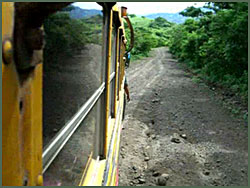 to bring in goods and supplies, all require a trip by bus (since only a rare few Limayians have trucks.) That trip takes 2 ½ hours and, if the roads are blocked by water, mud or rocks, villagers must wait for repairs in order to travel.
A newspaper article from October 6th, 2000 spells out the problem dramatically.
“The population of San Juan de Limay are unable to pass along the land route due to the bad condition of the roads …. Before the rains of the last weekend the route that unites Pueblo Nuevo with San Juan de Limay was difficult, now the conditions are terrible. This Wednesday the buses of the collective transport, because of the imminent danger of landslides and the enormous ravines that have occurred aong the routes, chose to discontinue service along the route. Those who need to make the journey to Estelà have to make it in their own vehicles yet most of the citizens have few economic resources. Those in Limay feel totally abandoned by the government.â€

Water Shortage – La Prensa, March 2002
San Juan de Limay is a town with the quality of a desert. The pueblo is undergoing a severe potable water shortage in the urban area and in rural localities like Tranqueras, Hermosillo and San Lorenzo. This has happened during several winters in recent times . The rivers, quemadas, and wells have all dried up bcause of the drought said Bismark Gutierrez Cross, the Municipal Mayor of San Juan de Limay, as he contemplates the possibility of declaring an “emergency situation†in the municipality because of the shortage of the vital liquid.
“The farmers of the affected communities have to go several kilometers to obtain water because the river has dried up”, the Mayor of Limay reiterated.